
Shelby County Arrest to Court Record
Shelby County jail arrest information and Shelby County court records are maintained in separate systems. The Sheriff's Office publishes an official Arrests page with a Power BI report for recent arrests and active inmate statistics, but that report is not the final source for filed charges. After the booking event, the criminal case moves through the county attorney, clerk, and Iowa trial-court system. The court record is where a defendant's filed charges, hearings, bond orders, dispositions, and later case events should be checked.
The custody side can still matter. If the question is whether someone is still in Shelby County Jail, use the jail inmate records workflow and the jail line. If the question is whether a booking photo is displayed or requestable, use the jail mugshots workflow. Court records after a jail arrest answer a different question: what case was filed, what charge level was used, whether the case is pending or resolved, and whether later action changed the original arrest charge.
A common mismatch is an arrest charge that does not match the court charge. Law enforcement may book a person under an initial suspected offense. The Shelby County Attorney can then file different, fewer, more, amended, or reduced charges after reviewing reports. That is why the court case should be treated as the main source for charge status after a Shelby County arrest.
Shelby County Court Records Search
Filed Shelby County criminal and traffic cases are searched through Iowa Courts Online. The public trial-court search can be used by name, case ID, or citation number. Advanced case search may require registration, but the simple trial-court search is the first public route for most people checking court records after an arrest. Results are tied to the court system, so recent booking data may appear in the sheriff report before the court entry is visible.
The official Iowa Courts Online search selection page is shown below from the project image manifest.
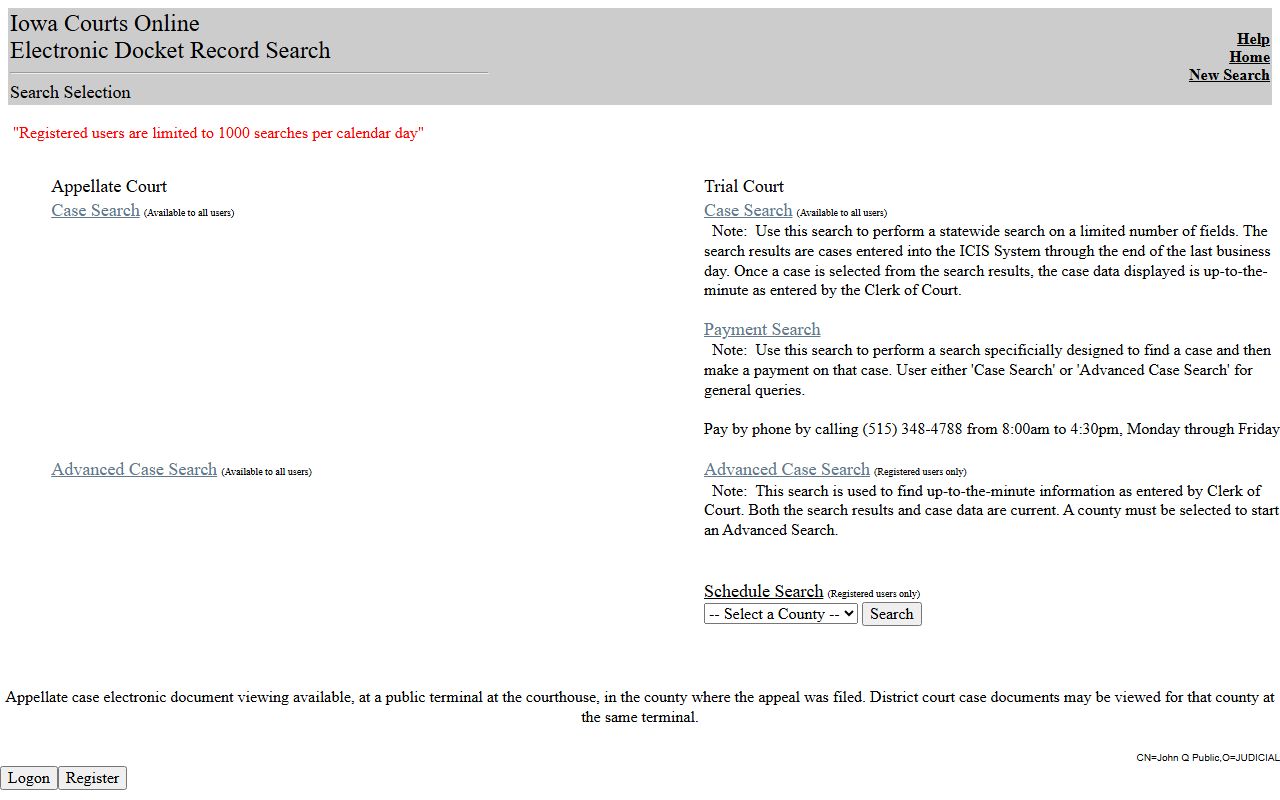
The court portal is the place to check filed cases, while the Shelby County Sheriff's arrest report remains the local custody and recent-booking source.
| Search Field | Type | Use | Notes |
|---|---|---|---|
| Last/Firm Name | Text | Name search | Use the defendant's last name when the case number is not known. |
| First and Middle Name | Text | Name search | Helps narrow common names and spelling variants. |
| Role | Dropdown | Name search | Select defendant for a criminal case lookup. |
| County | Dropdown | Recommended | Select Shelby to avoid mixing cases from other Iowa counties. |
| Case Type | Dropdown | Optional | Criminal, traffic, juvenile, and other categories may be available. |
| Case ID | Split fields | Case search | Codes include FE, AG, SR, SM, OW, NT, ST, and SW. |
| Citation Number | Text | Citation search | Useful when a citation was issued with the arrest or stop. |
After Shelby County Jail Arrest
The path from arrest to court record has several steps. The first step is booking or processing through Shelby County Jail. The second step is the initial court appearance. For an arrest on a warrant, Iowa Code 804.21 requires the person to be taken without unnecessary delay before the nearest or most accessible magistrate. For a warrantless arrest, Iowa Code 804.22 governs the initial appearance process. That early hearing can address rights, counsel, release terms, and future court dates.
- Check the sheriff's recent-arrests report if the concern is the booking event or current jail custody.
- Search Iowa Courts Online by defendant name, Shelby County, case type, case ID, or citation number.
- Open the case and compare each filed charge with the booking information, if both are available.
- Review bond, hearing dates, charge status, disposition, and any warrant or failure-to-appear entries.
- Contact the clerk for court record access questions and the county attorney for prosecution-office routing.
The court case may not appear at the exact same time as the jail booking. A delay can occur while reports are reviewed, a complaint is filed, or data is entered by the clerk. If a case cannot be found by name, search by citation number when one exists, use a date range if the search page allows it, and confirm spelling or aliases.
Shelby County Court Contacts
Iowa uses the County Attorney title for the local prosecution office. The Shelby County Attorney page lists Marcus Gross, Jr. as County Attorney and Jodee Dixon as Assistant County Attorney. The page states that the office represents the State of Iowa in criminal prosecutions. Iowa Code 331.756 supports that role by describing county attorney duties in state and county proceedings.
The official Shelby County Attorney contact page is the matched source image for prosecutor details.

Prosecutor contacts help identify the office that files charges, while the clerk is the court contact for case-file access and court-record questions.
Shelby County Attorney
711 Court Street
Harlan, IA 51537
Mailing: P.O. Box 509, Harlan, IA 51537
712-755-3141
Shelby County Clerk of Court
612 Court Street, P.O. Box 431
Harlan, IA 51537
712-217-6737
CountyClerk.Shelby@iowacourts.gov
Shelby County Charging Records
Charging records are the documents that turn an arrest into a formal court case. Iowa criminal procedure can use a complaint, trial information, indictment, or another allowed filing depending on the offense and stage. The terms matter because a booking report may use one label while the later court record uses another. The filed document, not the jail entry, controls the charge list in the court case.
| Document | Who Usually Starts It | What It Does | What to Check |
|---|---|---|---|
| Complaint | Law enforcement or prosecutor | Begins or supports a criminal charge based on sworn facts. | Offense name, date, probable-cause facts, and defendant identity. |
| Trial Information | County Attorney | Formal charging paper used by the prosecutor in many Iowa cases. | Charge level, statute, count number, and later amendments. |
| Indictment | Grand jury | Formal accusation returned through the grand-jury process. | Counts, offense class, and any superseding or amended filing. |
Each count can move on its own track. One charge may be dismissed while another is amended or resolved by plea. Read the status for each count, then check the disposition line before treating a charge as final.
Shelby County Charge Status
Charge status is the most important part of court records after a jail arrest. A pending charge is an accusation. A conviction is a court outcome after a plea or verdict. A dismissed charge is not a conviction. A deferred judgment is an Iowa disposition that may avoid a conviction if the person completes court-ordered terms. The status can change as the case moves, so one snapshot should not be treated as a complete history.
| Status | Plain Meaning | Why It Matters |
|---|---|---|
| Pending | The charge has been filed but not resolved. | Future hearings, bond terms, or amendments may still occur. |
| Amended | The filed charge changed from an earlier version. | The final case may differ from the arrest charge. |
| Reduced | The charge moved to a less serious offense or level. | Penalties and record meaning can change. |
| Dismissed | The charge ended without conviction on that count. | Other counts may still remain in the same case. |
| Acquitted | The defendant was found not guilty. | The charge was resolved in the defendant's favor. |
| Convicted | Guilt was adjudicated by plea or verdict. | Sentencing, probation, jail, or DOC custody may follow. |
Shelby County Bond and Warrants
Bond and release conditions are court issues after many Shelby County arrests. Iowa Code 811.1 states that Iowa defendants are generally bailable before and after conviction, subject to statutory exceptions. Iowa Code 811.2 favors personal recognizance or unsecured appearance bond unless conditions are needed to assure appearance or protect the public. Cash bond, surety bond, no-bond holds, and detainers should be checked in the court record and with the jail when release is the issue.
Shelby County also publishes an Active Warrant List through an embedded Power BI report. The sheriff's page warns that warrant data can change, accuracy is not guaranteed, citizens should not try to apprehend anyone, and warrant information is not given out over the phone. That means the public list is a lead, not a final legal confirmation. A warrant that leads to arrest can create a booking at Shelby County Jail and a court entry in Iowa Courts Online once the matter is entered.
| Release or Warrant Term | Meaning |
|---|---|
| Personal recognizance | Release based on a promise to appear and obey conditions. |
| Unsecured appearance bond | No upfront payment, but money may be owed if conditions are violated. |
| Cash bond | Money posted through the authorized court, jail, or vendor process. |
| Surety bond | A bail bond company posts bond under its own terms and fees. |
| Bench warrant | A judge-issued warrant, often tied to failure to appear or court-order violations. |
| Detainer or hold | Another agency or court must act before release can occur. |
Shelby County Court Record Limits
Public court records after a jail arrest need careful reading. Charges are not proof of guilt. Some court records are public, while juvenile, sealed, expunged, confidential investigative, safety, or protected information may be withheld. Iowa public-record access starts with Iowa Code 22.2, while Iowa Code 22.7 lists confidentiality exceptions and treats records of current and prior arrests and criminal history data as public unless another rule applies. Expungement is addressed in Iowa Code chapter 901C.
| Issue | Charge | Conviction |
|---|---|---|
| Case stage | Accusation filed in court. | Outcome after plea, verdict, or adjudication. |
| Proof level | Based on filing standards and probable cause. | Requires a guilty plea or proof beyond a reasonable doubt. |
| Record meaning | May be pending, amended, dismissed, or reduced. | May affect sentencing, custody, supervision, and later records. |
| Issue | Sealed | Expunged |
|---|---|---|
| Public view | Restricted from ordinary public access. | Removed from public access when the statute and order allow it. |
| How it happens | Usually by court rule, statute, or court order. | Through eligibility under Iowa expungement law and a court process. |
| Practical step | Ask the clerk what public access remains. | Use the court order when requesting record updates from agencies. |
Important: Court records after arrest are not consumer reports and should not be used for credit, housing, employment, insurance, or another FCRA-covered purpose.